Physicist Weather Simulations Run Program Again Different Results
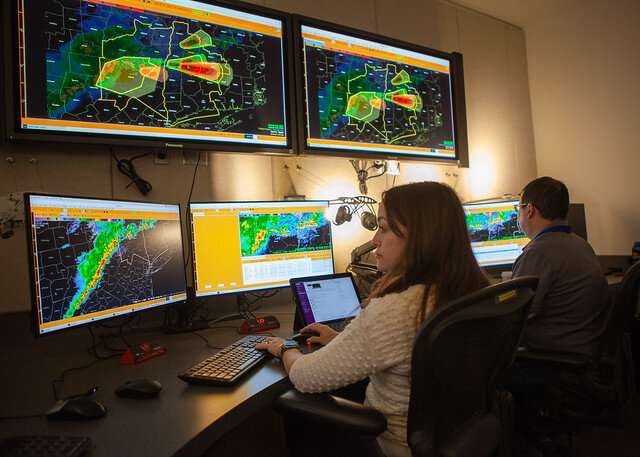
Each wintertime, spring, and summer, farthermost weather forecasters and researchers meet to test the latest, nigh promising severe atmospheric condition forecast tools and innovations to run across how they perform in existent-world settings.
These testbed experiments, orchestrated by the National Oceanic and Atmospheric Administration (NOAA), forecast wintertime storms, severe thunderstorms, and wink flooding respectively.
The Hydrometeorology Testbed recently held the 12th annual Winter Weather Experiment (WWE). An immersive, collaborative, "research-to-operations" experience, information technology brought together members of the forecasting, research, and academic communities to evaluate and discuss winter weather forecast challenges.
"We generate operational forecasts using new inputs or new models testing how well they piece of work," said Keith Brewster, senior research scientist and operations manager of the Centre for Analysis and Prediction of Storms (CAPS) at the Academy of Oklahoma. "If we hope a forecast where thunderstorms occur, tin can we expect a forecaster to use it?"
Humming forth in the background of the experiment are supercomputers at the Texas Advanced Computing Center (TACC)—among the fastest available to academic researchers in the world.
The CAPS squad began using TACC systems for the Chancy Weather condition Testbed Bound Experiment in 2011 to improve predict severe thunderstorms. They computed at that time on the original Stampede supercomputer at TACC—the 6th fastest in the world in its prime number. From 2017-2021, they used Stampede2 (12th fastest) through the Farthermost Science and Engineering Discovery Environment (XSEDE). Since 2021, they have used Frontera, the fastest academy supercomputer in the world and currently the 13th fastest overall.
"What TACC and XSEDE offer us is the ability to practice these real-fourth dimension or near-real-time experiments," Brewster said.
The CAPS team submits their forecasting simulations past 10:00pm, afterwards weather observations and other input data comes in for the 00 UTC cycle. The simulations run overnight and are ready by eight:00am the adjacent morning, predicting weather condition events out to three-and-a-one-half days.
"On Stampede, we worked with TACC to accept a special queue set upwards where we have a dedicated number of cores allocated to us," Brewster said. This type of "urgent computing" has go a authentication of TACC, enabling the center to forecast hurricane storm surge, monitor infinite junk in low Globe orbit, and power COVID-19 models. "More recently, on Frontera, the capacity is such that we tin run in the regular queue, using a VIP priority, making our use more efficient and less disruptive to other inquiry users."
This year'due south Winter Atmospheric condition Experiment had 3 key science goals: to subjectively gauge the utility of convection-allowing model (CAM) forecasts to improve two-to-three day snowfall forecasts; objectively score the snowfall forecasts using community standard verification systems; and determine the optimal combination of physics to utilize in next-generation models.
The team was primarily interested in predicting the amount of snow accumulation, merely they too tested their ability to determine the differences betwixt snow, sleet, and freezing rain in forecasts, and predict other facets of wintertime weather, like wind speed.
"Giving forecasters the opportunity to use these experimental models in existent situations allows forecasters and researchers to make up one's mind the strengths, operational challenges, and forecaster usability early on in the evolution stage," said James Correia Jr., coordinator for the Hydrometeorology Testbed. "This allows united states of america, together, in NOAA testbeds, to make improvements in our forecasting process, models, and the way we approach and solve enquiry and operational challenges."
Contempo testbed programs have also included the of import task of evaluating NOAA'due south adjacent-generation conditions model, the FV3 model. This model has shown success in global-scale forecasting, and the agency plans to also employ it operationally for much higher resolution regional modeling every bit represented in the high-bear upon testbeds. The new multi-calibration forecast organisation is known as the Unified Forecasting System (UFS).
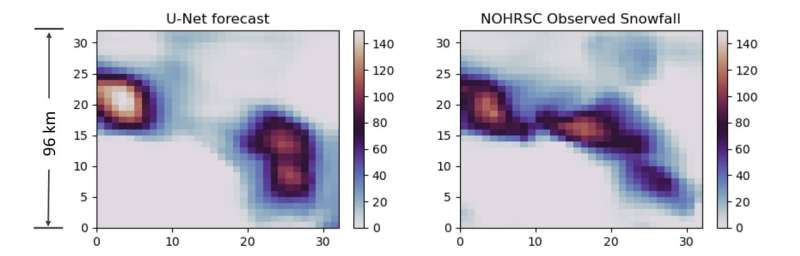
"In improver to real-time testing, CAPS has been using TACC supercomputers to rerun cases to identify the root cause of issues that were identified during prior testbeds," Brewster said. "This leads to tuning and other enhancements to the original codes."
The Winter Weather Experiment ran for 27 case days on Frontera in nigh-real-time over the form of the winter, including objective verification and machine learning training—a forrad-looking aspect of the inquiry. Brewster presented the results as a webinar organized past NOAA in March 2022.
Following the experiment, researchers typically do more detailed studies on specific facets of the forecasts, with funding from NOAA's Atmospheric condition Program Function as part of the Testbed competition in collaboration with NOAA's Weather condition Prediction Centre and Storm Prediction Center—both divisions of the National Weather Service.
Testing ensemble consensus methods
Near weather watchers are familiar with the idea of ensemble models—the swarms of tracks that represent the results from various simulations, which are averaged and interpreted by weather forecasters.
Using Frontera, Brewster's squad generates existent-fourth dimension ensemble forecasts.
"In decision theory, it has been shown that when you get a consensus of experts, you lot become better advice than from a single person," Brewster said. "Thank you to TACC, nosotros can generate 13 models—xiii 'experts' predicting what the weather is going to exist. From at that place, nosotros're working on how to develop ensemble consensus products that best help amend forecasts."
Sometimes usability past a homo operator trumps pure prediction skills. Communicating the consensus decision from an ensemble of forecasts is such an case.
"We researchers are in at that place, observing and participating, for one week—as if nosotros were in the weather condition office, creating forecasts, then people similar myself can see the issues," Brewster explained. "We attempt to be realistic: Tin can someone really await at ten to 15 models? Or does information technology create more than uncertainty?"
One approach the CAPS team has been exploring for ensemble consensus methods is the local probability match hateful (LPM) method. The LPM method divides an area into patches, calculates the atmospheric dynamics over that patch, and distributes the results locally. (Nathan Snook and the CAPS squad described the method, and compared diverse ways of computing this mean, in a 2020 paper in Geophysical Research Messages.)
An assessment of the accuracy by NOAA showed the local probability lucifer mean (LPM) performed slightly worse than probability friction match (PM) mean in objective atmospheric precipitation scoring.
"But this is where the testbed activities come up in," Brewster said. "When a human looks at a forecast, they're not looking at raw numbers at a site. They're looking at the shape—consensus reflectivity—and in this respect, LPM was accounted to be meliorate. That was a win for our squad."
The LPM has since been implemented in NOAA'south operational High Resolution Ensemble Forecast system. This is the goal of the NOAA Testbed program: taking research ideas and getting them through testing and evaluation in quasi-operational settings to bodily operational deployment.
"That'southward what we call engineering transfer," Brewster said. "In that location'southward a tech divide where researchers like our team work on models, produce papers, and it tin can be hard to become new models or concepts into the operations. Tech transfer happened because it was proven, not just running on TACC and to other researchers, but to other forecasters. That gets usa over the split up from periodical articles to impacting existent-world forecasts."
More than information: Nathan Snook et al, Comparison and Verification of Point‐Wise and Patch‐Wise Localized Probability‐Matched Hateful Algorithms for Ensemble Consensus Precipitation Forecasts, Geophysical Enquiry Messages (2020). DOI: 10.1029/2020GL087839
Citation: Adjacent-generation weather models cross the divide to real-world touch on (2022, May eighteen) retrieved 21 May 2022 from https://phys.org/news/2022-05-next-generation-weather-existent-world-impact.html
This document is subject to copyright. Apart from whatever fair dealing for the purpose of private written report or research, no part may be reproduced without the written permission. The content is provided for data purposes just.
santiagoupostaing.blogspot.com
Source: https://phys.org/news/2022-05-next-generation-weather-real-world-impact.html
0 Response to "Physicist Weather Simulations Run Program Again Different Results"
Post a Comment